


Picture
Also known as the Alsatian or GSD, the German Shepherd is a well-proportioned, very strong (both mentally and physically) dog. They are very sturdy with a muscular frame, they have an elongated body and light, yet solid bone structure.
There are 3 varieties of the GSD, double coat, plush coat and long haired coat. The coat comes in black with tan, all black or sable but can also come in white, blue and liver – though these colours are considered a fault to most standards. The White Shepherd is recognised as its own breed, being known as the American White Shepherd.

The German Shepherd originated in Karlsruhe, Germany from Captain Max von Stephanitz and other dedicated breeders who produced an obedient and handsome dog. They did this by mixing longhaired, shorthaired and wire haired herding and farm dogs locally from Wurtemberg, Thurginia and Bavaria.
They were first presented in 1889 in Hanover with the shorthaired variety first seen in Berlin in the same year. In April 1899, von Stephanitz registered a dog named Horan, the first Deutsche Schäferhunde, which in English translates to ‘German Shepherd Dog.’ Until 1915, both the wire haired and longhaired varieties were shown. The first GSD to be shown in American wasn’t until 1907.

Today, the German Shepherd makes a great family companion but are also ideal working dogs. They are very courageous and fear nothing, they will put their own life on the line for the family. They are a keen, alert and very smart dog, making training simple for the right owner. As all dogs, they require a strong and firm pack leader otherwise can be a destructive pet. They need a stable environment and consistent training. They simply will not listen if they feel at any point that they are stronger and have the upper hand. They are one of the smartest and most trainable breeds and need to be well understood.
Their natural protective instinct makes them great for families and ideal for the line of work as Police Dogs. They bond very close to their family and can be wary of strangers. They will only bark when they feel necessary and require good socialization from a young age. Any behavioural issues are a clear indication of poor handling and training.
They require a high level of mental and physical daily stimulation and should not be left on their own for long periods of time. They are not a breed they will enjoy being locked in the back yard or laze around the house all day. Their mind needs to be kept busy and complete ‘jobs’ that are set for them.
They do excellent in tracking and obedience as well as agility work.

Sadly, bad breeding is common today and hereditary problems such as hip and elbow dysplasia are being seen more. Being a large dog they are prone to bloat and for this reason, feeding should be well monitored. Breeders should be thoroughly researched prior to the purchase of a pup.
They are generally a large size dog, with males growing up to 65cms and females to 60cm. Their coat requires some upkeep as they are heavy shedders. Daily brushing is ideal and bathing only when necessary.

The GSD makes a great pet and work mate but needs to be well understood before being considered. They need an owner who is able to put in the time and effort and in the end, be rewarded with a best mate for life.


Picture
Our good mate, Colin.
 
 
'Never stand between a dog and the hydrant.'
                                                       - John Peers


We all love our dogs and for some of us, leaving them at a boarding facility can be very scary.
Sadly, we can sometimes pass this fear and nervousness onto our dog and make the situation worse than it needs to be.

One of the most common things we hear at Dogs Country Club is, ‘my dog is a rescue dog and I’m worried if I leave them they will think they’re being dumped again,' or 'they'll think I'm not coming back.'

Luckily, this is not the case. Regardless of your dog’s previous experiences they don’t compare circumstances. When a dog comes to stay at Dog’s Country Club they are pampered with their every need met, even though you are not around dog’s are very easy to keep happy and as long as their needs are met, they have no reason to stress or be anxious.

Dog’s feed off our energy, that’s why it’s common for dog’s to act differently on leash when with their owners and they will react to the energy around them. If you are nervous or upset when leaving your dog (wether is be at the vet, groomers, boarding kennel etc) the best thing you can for them is to be positive whilst they’re around. You will notice a difference straight away, keep everything quick and easy. By showing them you are nervous you are giving them something to worry about, when in fact it’s a perfectly save situation. Once they are out of sight and you have separated yourself from your dog then you can let your emotions out.
Learning your dog’s body language can be very helpful at time. For example, seeing a dog shaking can mean a number in the dog world though most of us see this as nervous behaviour, this can actually be your dog’s way of showing excitement!
Dog’s do not have a concept of time like us humans do. We understand each new day though dog’s have a completely different routine, they nap throughout the day there for don’t understand when a new day starts or ends. This is why your dog will react the same to you when you pick them up from a long term holiday just as they would if you gone to the shops for milk and bread.

Making new situations positive is healthy for everyone involved and makes everything easier. It’s best to expose your dog to new situations and sounds from a young age and make sure your confident during the whole experience. You will find later in life that you and your doggy will able to share in great things together and enjoy lots of new things in life.


We hope everyone is keeping nice and warm. We've come across such a beautiful story and just had to share it with everyone!
  This is Lily and Maddison, two best friends that are inseparable.
Unfourtunaly, a rare illness when she was a pup caused Lily's eyelashes to grow into her eyes and cause damage beyond repair. It was at that point she had both her eyes removed and sadly the future looked glim for her. To everyones suprise, Maddison stepped up as Lily's guide dog and the two have never been apart since. They are very vocal with each other and Lily's loss of sight hasn't prevented her from doing anything, thanks to Maddison.
Lily, now 6, and Maddison, 5 spend there days chasing each other and cuddiling together in bed. They never leave each other's side.
Enjoy the weekend,

Gemma & Frodo.


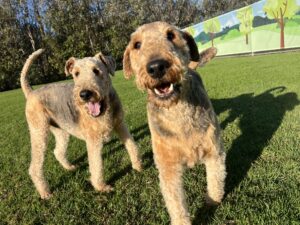
PictureRiley and good mate Jasper
The Airedale Terrier is the largest of all the terriers and stands to a medium height with a square appearance. The breed was developed about 100 years ago in the country of York and was originally known as Waterside and Bingley Terriersand. They had descended from the now extinct tan and black type terrier and were later cross bred with the Otterhound to improve their swimming. Their name arose from the Valley of the Aire in England which was heavily populated with small game, it was here they were used as vermin hunters. They were also used to hunt big game throughout India, Africa and Canada. Over the years they have been police dogs and a wartime guard during World War II.

Today they are primarily a companion dog, though through the generations of breeding the Airedale today looks completely different to the original line. They are a courageous and protective dog who, if socialized well, can do well with children though can play a little rough with very small ones. They need obedience training at a high level and are very responsive. They are a fun loving and playful pup and are always happy to please. The Airedale is an extremely loyal dog but is a natural hunter so will need to keep a watchful eye if any smaller pets are around. They are a very rowdy and lively dog and require a high level of daily mental and physical exercise. This, along with stern training, will stop them from becoming bored and destructive and remind them who the ‘Top Dog’ and ‘Pack Leader’ is. An Airedale who feels they are in charge will become disobedient but remember they do not respond well to overbearing or harsh forms of training They are a very intelligent dog and smart enough to perceive quickly what is required of them, but if asked to do the same thing continuously may refused. A confident but firm and consistent handler is ideal to make the best relationship.

As the Airedale was bred for very active lines of work they do require a large amount of exercise and therefore are not ideal for apartment living. They are quite inactive in doors but do need a large yard to move around it as well as long daily walks or runs. Most enjoy ball play and swimming and are a lot more active during their first few years of life, tending to mellow out over time. Their short haired, hard double coat needs to be plucked at least twice yearly. With the correct grooming care they will shed little to no hair. Unfourtunatly with the Airedale daily brushing is not sufficient enough to maintain their coat. Their beards can easily get dirty after eating so many need daily cleaning also. They are a very hardy breed and don’t tend to have many health problems if cared for correctly.


... maybe you just need a hug!
 
 
PictureOur dear friend Axle.
The Siberian Husky is a laid back, high energy dog that originated off the eastern Siberian peninsula. They were used for centuries by the Chukchi Tribe for herding reindeer, pulling sleds and as watch dogs. They are hardy dogs so were ideal to work in those harsh, cool climates. They are strong dogs so were able to work for hours on end and integrate into small packs. They were brought to Alaska by fur traders in Malamute for races due to their great speed. In 1908 they were used in the first All Alaskan Sweepstakes, a competition that had mushers take their dogs on a 408 mile long sled race. They gained even more popularity in 1925 when they were used in Alaska for bringing in much needed medicine when the diphtheria epidemic hit.
They were also used during World War II in the Army’s Arctic Search and Rescue Unit. Today they make great family pets and generally get along with everyone and everything. They are loving, gentle and happy go lucky. They are very docile, social and relaxed so don’t actually make that good of a watch dog, being very friendly with strangers.

They are great with children and bark very little, preferring to howl. They are an extremely high energy dog, very intelligent and easily trainable, if done correctly. They will only respond to proper training if the owner always asserts dominance and shows they are stronger minded. Allowing them to believe they are stronger, will result in a dominating, misbehaving dog Training with Huskies takes patience, consistency and a good understanding on their character.
If you can’t be 100% firm, confident and the pack leader they will take advantage of you. Being a high energy dog, the Husky requires a lot of exercise. This will help prevent boredom and keep their mind stimulated. Being intelligent, they get bored extremely easily; this is when their mischievous behavior starts. Remembering though, due to being bred for colder climates, exercise in warmer weather needs to limited to the cooler parts of the day. They will also howl when bored and do not do well being left alone for long periods of time.
Always keep in mind they are working dogs in heart and soul, without enough mental and physical exercise they will cause some trouble. Their thick coat sheds heavily twice a year and needs to be brushed daily, especially during shedding times. Not only are Huskies great with people, but if raised correctly from a young age are great with other pets. They make a great companion for anyone who has the time energy to put into them; in return you receive a great friend for life.


Picture
We'd like to introduce you to our June Dog of the Month - RILEY!

Riley is a beautiful Airedale Terrier who has many friends here at the Resort. He is just bursting with personality and is sure to be entertaining for the rest of the Month.